What is the Iran war costing UK households? The real numbers

Since the United States and Israel began military strikes on Iran on 28 February 2026, the conflict has disrupted oil and gas supplies across the Middle East, including shipping through the Strait of Hormuz. The UK imports much of its energy, so the effects have reached British households quickly. Here's where it's hitting your money, using the latest official figures.
The headline numbers (early October 2026)
Petrol: 173.5p a litre, up 41.8p since the war began.
Diesel: 197.6p a litre, a record high, up 56.1p.
Average two-year mortgage fix: 5.96%, up from 4.85% in February.
Inflation: 3.1% in August, and expected to rise further.
How a war abroad reaches your wallet
There are three main routes. Higher oil prices push up petrol and diesel. Higher gas prices push up energy bills. And because both make everything else cost more to produce and transport, inflation rises, which means interest rates stay higher for longer, and that feeds straight into mortgage rates.
Fuel: the biggest and fastest hit
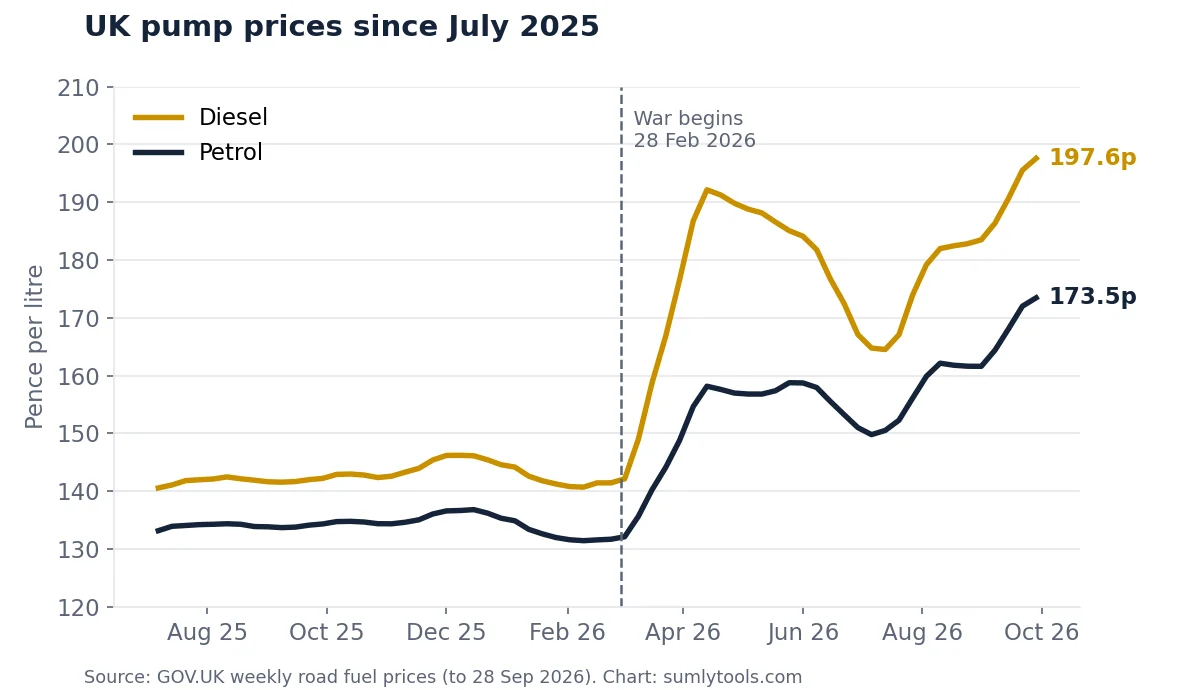
In the week before the war, petrol averaged 131.7p a litre and diesel 141.5p. By 28 September they had reached 173.5p and 197.6p, rises of about 32% and 40%. Prices eased over the early summer, then climbed again as attacks on shipping and energy sites resumed. On RAC figures, diesel passed its previous record from 2022 at the end of September.
Filling a 55-litre family car now costs about £23 more for petrol and £31 more for diesel than in February. Over a typical 10,000 miles a year, that's roughly £420 extra for a petrol car doing 45 mpg, and £510 for a diesel doing 50 mpg.
Diesel has risen faster because global supplies of refined diesel have been especially tight. There's also a further pressure ahead: the RAC has warned that if the temporary fuel duty cut is reversed as planned, it would add about 5p a litre by the spring.
Energy bills: gas up, electricity cushioned
Higher wholesale gas prices pushed Ofgem's price cap up 4% on 1 October, to £1,723 a year for a typical dual-fuel household in Great Britain, £60 more than before. Gas bills are up about 8%, but electricity is broadly flat because VAT on electricity was removed at the same time.
In Northern Ireland, energy prices are set differently and most homes heat with oil, whose price has risen with the crude oil price. Two forms of help are available this winter:
- A £63 electricity credit for around 860,000 NI households, applied automatically from 6 October.
- A £100 Home Heating Oil Support digital card for around 340,000 households that heat with oil and receive a qualifying benefit or have an income under £30,000. You must apply, on nidirect, by 31 March 2027.
Inflation is rising again
Consumer price inflation was 3.1% in the year to August, up from 2.9% in July, with higher fuel prices a big part of the rise. Before the war, inflation had been expected to fall towards the Bank of England's 2% target this year. Instead, the Bank now expects it to reach about 3.75% by the end of 2026 and slightly above 4% in early 2027, based on recent energy prices.
Interest rates and mortgages
Before the war, the Bank of England was expected to keep cutting its base rate. It has instead held at 3.75% all year, and at its September meeting three of the nine committee members voted to raise it to 4%. Markets now expect rises rather than cuts. The next decision is on 5 November.
Lenders price fixed mortgages on where they expect rates to go, so fixed deals have jumped. According to Moneyfacts, the average two-year fix was 5.96% at the start of October, up from 4.85% in early February, and deals below 5% have almost disappeared.
| Mortgage (25 years) | At 4.85% (Feb) | At 5.96% (Oct) | Extra a month |
|---|---|---|---|
| £200,000 | £1,152 | £1,284 | £132 |
| £250,000 | £1,440 | £1,605 | £165 |
If you're on a fixed deal, nothing changes until it ends. The people feeling this now are those remortgaging or buying. There is one upside: savers are likely to see better rates if the Bank raises its base rate.
Putting it together
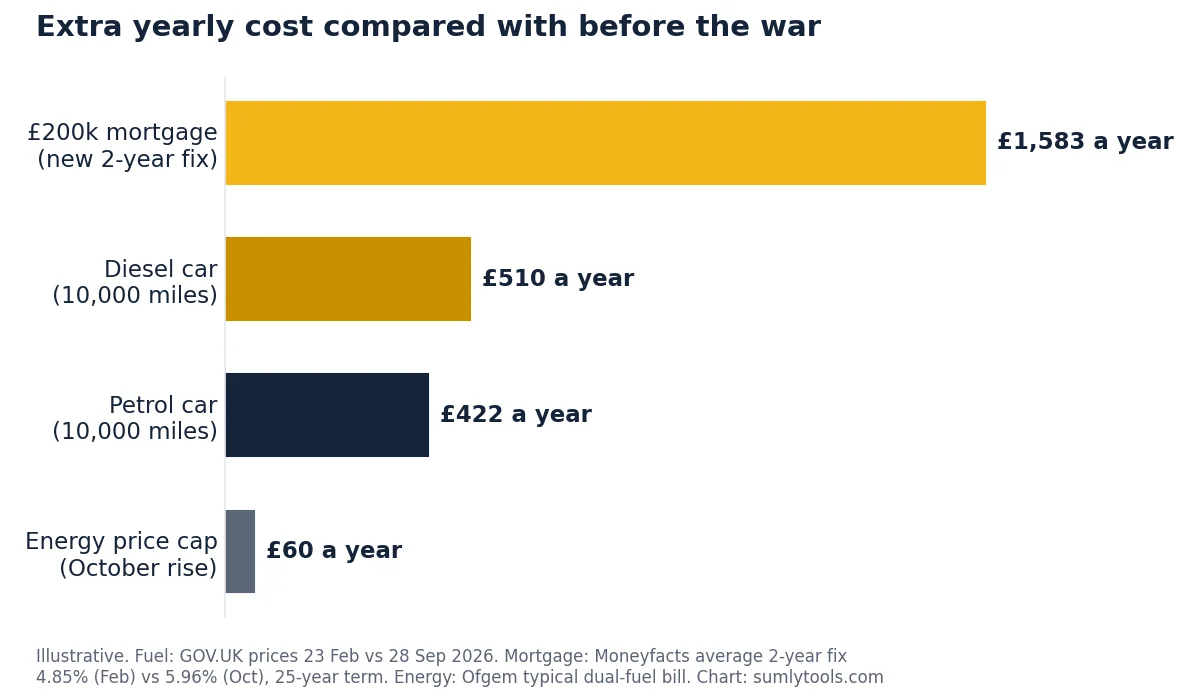
A household that drives a diesel car and remortgaged a £200,000 loan this autumn could be paying more than £2,000 a year extra compared with February. A household with a fixed mortgage and an electric car charged at home will have felt much less.
What it means for the government
The squeeze isn't only on households. The interest rate the government pays to borrow has also risen, with the 30-year gilt yield reaching 6% this week, its highest since 1998. Higher borrowing costs leave less room for tax cuts or spending, which matters for the Autumn Budget on 28 October.
What you can do
- Fuel: supermarket forecourts are usually a few pence a litre cheaper than the big brands. Check prices before you fill up.
- Mortgage ending within six months? Many lenders let you secure a new deal up to six months ahead, and you can usually switch if rates fall before it starts. Speak to a broker or your lender. Use the mortgage calculator to see what a new rate would cost you.
- Energy: compare fixed tariffs against the price cap, and if you're in Northern Ireland and eligible, apply for the oil support card.
- Savings: if rates rise, make sure your savings are earning a competitive rate. The savings calculator shows the difference a better rate makes.
- Thinking about an EV? Home charging has been largely shielded from oil prices. Compare costs with the EV running cost calculator.
How long this lasts depends on events far from the UK. Prices could fall quickly if oil and gas start flowing normally again, or rise further if the disruption deepens. We'll update this guide as the figures change.
Sources
- House of Commons Library: Middle East conflict and the UK economy
- GOV.UK: Weekly road fuel prices
- ITV News: UK diesel prices hit all-time high, RAC figures show
- Ofgem: Energy price cap will rise by 4% from October 2026
- ONS: Consumer price inflation, UK, August 2026
- Bank of England: Monetary Policy Summary, September 2026
- Mortgage Strategy: Average fixed rates on brink of 6% (Moneyfacts)
- Department for the Economy NI: £63 electricity discount
- Department for Communities NI: £100 Home Heating Oil Support Scheme
- Bloomberg: UK bond market borrowing costs
Published 3 October 2026. This guide explains the financial effects of the conflict; it doesn't take a political position. Figures are correct at the time of writing and will change.